Sustainability Management in Environmental Dimension
The Company has committed to conducting business while caring for the environment. Though the Company provides financial services, we pay attention to environmental issues, especially Climate Change which has become more intense, and find out solutions and prevention to mitigate possible negative impacts on the environment and nature. The related environmental issues are energy and water consumption, waste generation, pollution creation, and greenhouse gas emissions. Thus, the Company has formulated the safety, health and environmental policy and its guidelines to ensure that directors, executives, and employees realize their duties, responsibilities, and cooperation in managing those matters. The policy is provided on the website: https://investor.ifscapthai.com under “Sustainable Development.”
File download
Company’s Safety, Health and Environmental Policy
DownloadPerformance in Environmental Dimension
The Company is committed to promoting and improving environmental management both inside and outside the organization. Various projects and activities have been implemented to build environmental awareness and instill environmental consciousness among employees at all levels, while encouraging them to participate in initiatives provided to ensure the efficient and optimal use of resources.
In addition, the Company has set targets to reduce resource and energy consumption across the organization, including water and paper usage, and waste management. A base year has been defined as a reference point for comparison with the current year’s performance, enabling the Company to continuously monitor and assess progress in resource utilization in an efficient and sustainable manner. In terms of energy management, water consumption, paper usage, and waste management, the Company has initiated the preparation of its Carbon Footprint for Organization (CFO) and set targets to reduce resource consumption since 2023. Therefore, the performance in 2023 is used as the base year for comparison with that in 2025.
Electricity Consumption
In 2025, the Company continued the energy-saving campaign by regularly communicating with the employees through the existing channels such as e-mail notifications, office announcements etc., aiming at raising awareness among the employees to use energy efficiently and effectively. Thus, the guidelines have been implemented as follows:
- Replacement of 2 large-scale air conditioners in the office from the YORK Embassy Water-Cooled Packaged model to the Package Water Cooled Inverter Carrier 50BV Series with a higher Seasonal Energy Efficiency Ratio (SEER), which is an indicator used to measure energy efficiency, reducing electricity consumption in the long term. In addition, regular cleaning of air filters helps air conditioning systems operate efficiently and effectively.
- Set up the daily period of turning off air conditioning from 12.00-13.00 hrs.
- Set up the air conditioning temperature at 25ºC.
- Close computer screens and turn off all unused light tubes.
- Unplug any unused electrical equipment during and after working hours.
- Use energy-saving and standard light bulbs and electrical appliances and regularly check and maintain them in proper condition.
Electricity Consumption (kilowatt-hour)
| 2023 | 2024 | 2025 | Change (%) |
|---|---|---|---|
| 212,576 | 178,605 | 152,605 | -28.21% |
In 2025, electricity consumption decreased by 59,971 kilowatt-hours, or 28.21%, compared with 2023 (base year), due to the Company’s ongoing implementation of energy-saving measures. As a result, the Company achieved its target of a 3% reduction in electricity consumption within 5 years (2024–2028). Accordingly, the Company has set a further target to reduce electricity consumption by an additional 5% within 5 years (2024–2028) and implemented additional measures to enhance energy efficiency, optimize electricity use, and reduce greenhouse gas emissions.
Fuel Consumption
In 2025, the Company provided 9 company cars for various company activities. Under ongoing campaigns, the Company encouraged the employees to plan their traveling more efficiently to shorten the time and reduce fuel consumption by using public transportation for short distances i.e. electric train, taxi, etc. This helps create a traveling culture among the employees to care for the environment and reduce the operating costs and long-term environmental impact.
Fuel Consumption (Liter)
| 2023 | 2024 | 2025 | Change (%) |
|---|---|---|---|
| 16,926 | 15,935 | 16,813 | -0.67% |
In 2025, fuel consumption decreased slightly by 113 liters, or 0.67%, compared with 2023 (base year), while it increased by 878 liters, or 5.51%, compared with 2024, due to higher operational activity and increased work-related travel by employees. The Company recognizes the environmental impact and is committed to implementing measures to control and improve energy efficiency, aiming to reduce greenhouse gas emissions in the long term.
The Company set a long-term target to reduce fuel consumption to zero (0) within 5 years (2024-2028) by changing all 9 company cars from combustion to electric vehicles by the year 2028 to lower fuel costs and support the Company’s measures on the reduction of greenhouse gas emissions.
Water Management
Under ongoing campaigns, the Company has urged all employees to use water efficiently and economically while regularly checking equipment to ensure they are in proper condition.
Water Consumption (Cubic Meter)
| 2023 | 2024 | 2025 | Change (%) |
|---|---|---|---|
| 479 | 570 | 501 | +4.59% |
In 2025, water consumption increased by 4.59% compared with 2023 (base year) due to regular water use within the organization. This performance indicates that the Company has not yet achieved its 3% water consumption reduction target within five years (2024–2028); therefore, the Company will maintain the same target for the period. The Company will also closely monitor water usage across its operations, regularly inspect water-related equipment to ensure proper conditions, and promote water-conservation awareness among employees to encourage responsible and efficient use.
Paper Consumption
The Company has continuously campaigned for the employees to reduce paper to help decrease waste generated and the use of natural resources necessary for paper production. The Company, therefore, focuses on improving its working process and on utilizing technology to serve the set target as follows:
- Use an e-Factoring system to enable clients to submit documents online to reduce paper use in their work.
- Develop and implement the Salesforce Program as a core program in the Company’s business operation to help reduce paper use in printing.
- Encourage document storage and sharing of digital files through the Cloud System or online platform.
- Support real-time document editing through file sharing to reduce printing in the working process.
- Deliver documents via e-mail or online instead of paper-based formats.
- Encourage the employees to print documents only when necessary and use paper more efficiently.
Paper Consumption (Ream)
| 2023 | 2024 | 2025 | Change (%) |
|---|---|---|---|
| 955 | 890 | 970 | +1.57% |
In 2025, paper consumption increased slightly by 15 reams, or 1.57%, compared with 2023 (base year). This performance indicates that the Company has not yet achieved its target of a 3% reduction in paper consumption within 5 years (2024–2028), due to the higher volume of documents required to support increased operational activities. Therefore, the Company will continue to maintain the same reduction target for the period. However, the Company recognizes the importance of efficient resource utilization and plans to promote paper reduction by adopting digital documentation, thereby mitigating environmental impacts over the long term.
Waste Management
The Company recognizes the importance of waste management within the organization and promotes proper waste management practices among employees, including waste separation, plastic reduction, efficient use of office supplies, and reuse of office materials.
Volume of Waste in the organization (kilogram)
| 2023 | 2024 | 2025 | Change (%) |
|---|---|---|---|
| 3,892 | 3,527 | 4,017 | +3.21% |
In 2025, the volume of waste within the organization increased by 125 kilograms or 3.21% compared with 2023 (base year). This performance indicates that the Company has not yet achieved its 3% waste reduction target within 5 years (2024–2028), due to increased internal operational activities and staff events. Therefore, the Company will continue to maintain the same reduction target for the period.
“Waste Bank for Shared Happiness” Project
In 2025, the Company organized a CSR activity under the “Waste Bank for Shared Happiness” project to urge employees to participate in managing waste generated within the organization. The Company also campaigned to separate waste under the 3R principles which include “Reduce”, “Reuse”, and “Recycle”.
Under this project, the Company systematically separated waste and forwarded it to the Office of Lumpini Tower’s Waste Separation Program, where it was subsequently sent to a waste management service provider for proper and efficient waste management, including separation, collection, transportation, and disposal. This process helps minimize environmental impacts over the long term.
In addition, the Company provided rewards to employees who participated in the “Waste Bank for Shared Happiness” project and encouraged continuous engagement from all departments. A recording and monitoring system was established to track the volume of waste separated over each period, fostering constructive competition and motivating employees to recognize their roles in environmental stewardship within the organization. These initiatives also helped build a sense of pride in being part of waste reduction efforts and in contributing to the sustainable conservation of natural resources.
The “Waste Bank for Shared Happiness” project also created positive outcomes for the environment and employees’ public awareness. Waste separation and recycling helped reduce the world’s burden and create long-term sustainability in line with the Company’s purpose to operate the business along with environmental conservation.
Coral Planting Project, Sattahip District, Chonburi Province
On 26 April 2025, the Company organized a corporate social responsibility (CSR) activity under the “Coral Planting” project at the Marine Science Center, Sattahip District, Chonburi Province, with active participation and strong cooperation among the Company’s employees.
Coral reefs are vital marine resources that play a significant role in the ecosystem, serving as habitats and food sources for a wide variety of marine life. They also help maintain the balance of coastal ecosystems and reduce the impact of wave energy along shorelines. However, coral reefs in many areas are currently facing degradation due to climate change, marine pollution, and human activities.
The Company recognized the importance of actively participating in the conservation of marine natural resources through both support and hands-on involvement, with the objectives of contributing to ecosystem restoration and fostering environmental awareness among employees.
This activity resulted from collaboration between the Company’s executives and employees. Every year, the Company plans to organize useful activities alongside its business operations by focusing on caring for the environment, society, and communities to achieve sustainable living in the long term.
Table: Assessment Results of Greenhouse Gas Emissions, by the Company’s Activities in 2025
| Base Year (2021) | Current Year (2025) | Change (%) | |||
|---|---|---|---|---|---|
| Corporate Emission of Greenhouse Gases (Ton CO2e) |
Proportion (%) | CorporateEmission of Greenhouse Gases (Ton CO2e) |
Proportion (%) | Increase / (decrease) | |
| Scope 1 | 43 | 31 | 42 | 31 | (2.3) |
| Scope 2 | 81 | 58 | 77 | 57 | (4.9) |
| Scope 3 | 16 | 11 | 16 | 12 | 0 |
| Total (Scope 1+2) | 124 | 89 | 119 | 88 | (4.0) |
| Total (Scope 1+2+3) | 140 | 100 | 135 | 100 | (3.6) |
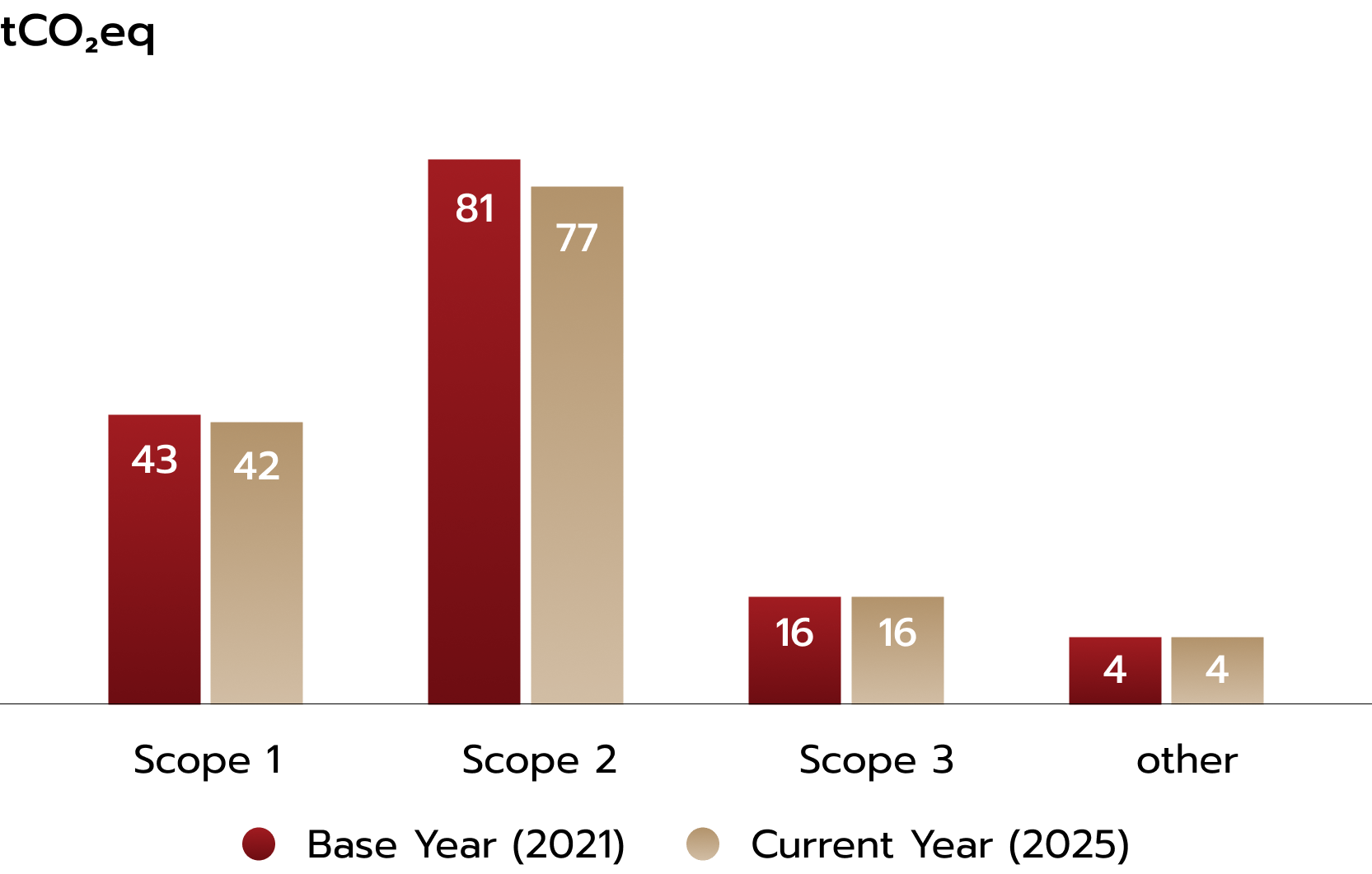
In 2025, the assessment results of the Carbon Footprint for Organization (CFO), compared with the base year 2021, indicated that the quantity of Scope 1 and Scope 2 greenhouse gas emissions was 119 tons Carbon Dioxide Equivalent (tCO₂eq) or a decrease of 4% from the base year 2021. Such base year corresponded to a period during which the Company operated under a Work from Home (WFH) arrangement due to the COVID-19 pandemic.
When compared with 2024, in which total Scope 1 and Scope 2 greenhouse gas emissions amounted to 137 tons of carbon dioxide equivalent (tCO₂eq), the Company’s total Scope 1 and Scope 2 greenhouse gas emissions in 2025 decreased by 13%. This reduction was mainly due to the Company’s continued implementation of measures to improve energy and resource efficiency across its operations, including effective electricity management, the use of energy-saving electrical equipment, fuel consumption control, and the promotion of employee green behaviors.
In 2025, the Company achieved its target to reduce Scope 1 and Scope 2 greenhouse gas emissions by 3% within 5 years (2024–2028), compared with the base year of 2021. Accordingly, the Company has increased its long-term target to further reduce Scope 1 and Scope 2 greenhouse gas emissions by an additional 5% within 5 years (2024–2028). In the future, the Company plans to reduce greenhouse gas emissions by promoting employees’ use of public transportation, replacing the Company’s vehicles with electric vehicles (EVs), selecting energy-saving equipment, and ensuring proper maintenance of equipment and systems. These initiatives aim to promote efficient resource utilization and reflect the Company’s commitment to environmental responsibility and society.
Performance in Reducing Greenhouse Gas Emissions within the Organization
Under the Climate Care project implemented by the Stock Exchange of Thailand since 2020, the program aims to encourage listed companies and other interested organizations to participate as members and conduct business in accordance with sustainable practices that take social and environmental considerations into account. The project also emphasizes effective management and reduction of greenhouse gas emissions arising from activities that contribute to greenhouse gas generation, a key driver of global warming. In this regard, the program promotes the establishment of greenhouse gas reduction targets to achieve carbon neutrality and net zero greenhouse gas emissions (Net Zero Emissions).
In 2025, as a result of the Company’s implementation of energy conservation initiatives and efficient resource utilization, the total greenhouse gas emissions from all activities decreased by 12.51 tons of carbon dioxide equivalent (tCO₂eq), equivalent to the annual carbon dioxide (CO₂) absorption capacity of 1,317 trees. This reflected the positive results of the Company’s tangible environmental measures and the strong collaboration of employees at all levels in driving the organization toward sustainable business operations. The performance outcomes for each activity are as follows:
Reduction of Electricity Consumption
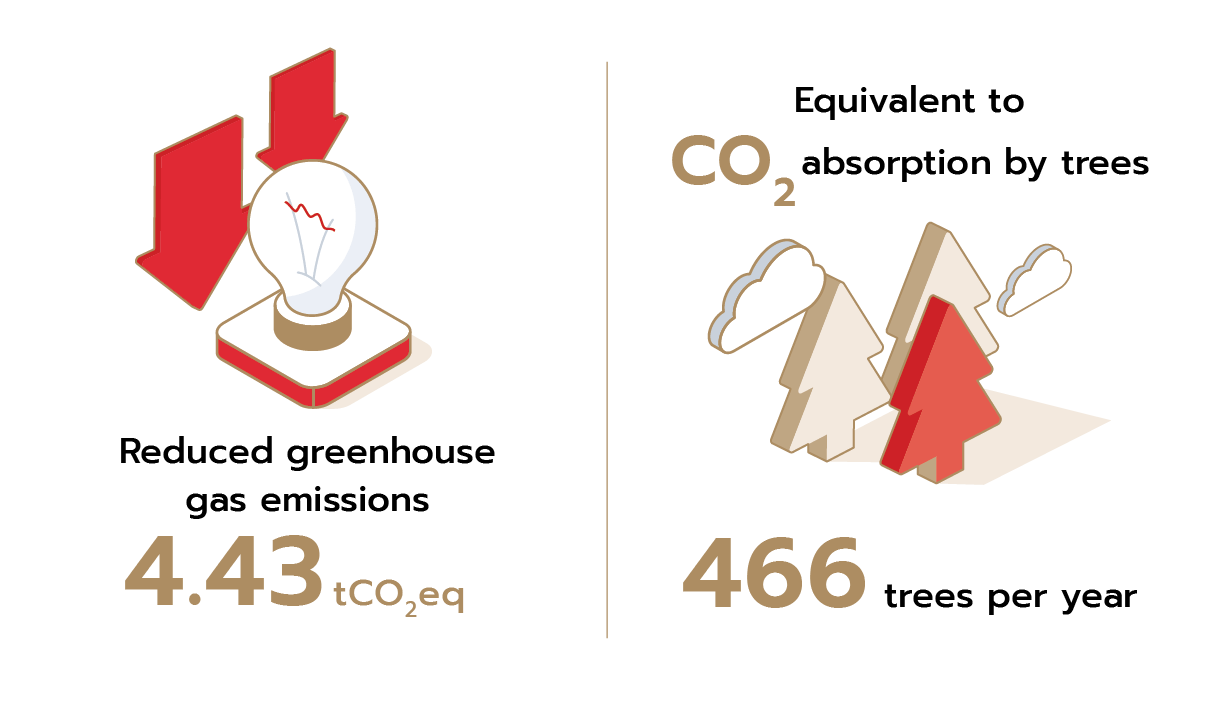
In 2025, the Company committed to continuously reducing electricity consumption within the organization to enhance efficiency and cost-effectiveness. As a result, greenhouse gas emissions from electricity usage decreased by 4.43 tons of carbon dioxide equivalent (tCO₂eq), equivalent to the annual carbon dioxide (CO₂) absorption capacity of 466 trees. This achievement reflected an approach to resource management, together with efforts to raise employee awareness of responsible energy use and encourage active participation in reducing environmental impacts.
Reduction of Paper Consumption under the TSD Care the Bear Project
The TSD Care the Bear project is an initiative jointly implemented by Thailand Securities Depository Co., Ltd. (TSD) and the Stock Exchange of Thailand to promote paper reduction in operational processes of listed companies. The project encourages a transition from paper-based documents to digital formats for materials provided to shareholders for the Annual General Meeting of Shareholders (AGM). This process helps reduce resource consumption, operating costs, waste generation, and environmental impacts efficiently.
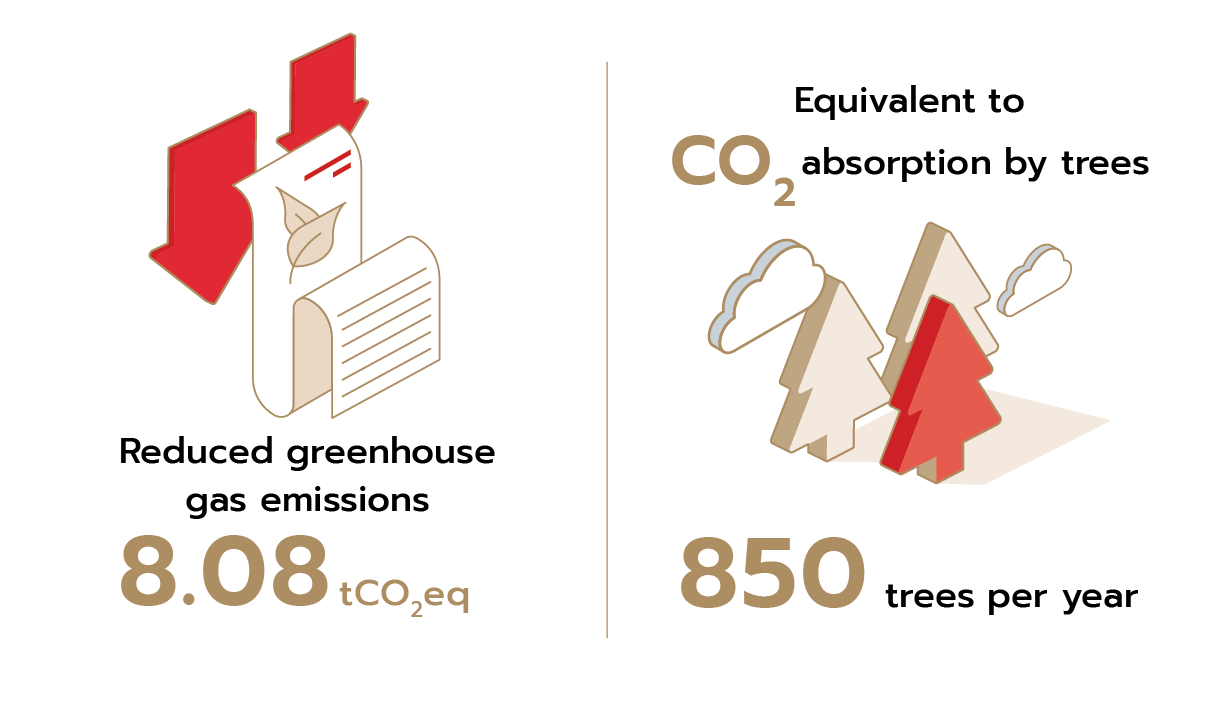
Under this project, in 2025, the Company’s paper consumption decreased by 583,176 sheets, and the total greenhouse gas emissions from paper usage were reduced by 8.08 tons of carbon dioxide equivalent (tCO₂eq), equivalent to the annual carbon dioxide (CO₂) absorption capacity of 850 trees. These outcomes reflected the implementation of integrating digital technology into the Company’s operations, while also encouraging shareholders and stakeholders to participate in the efficient and responsible use of resources.
Although the Company has not yet achieved its greenhouse gas reduction targets in the aforementioned areas of fuel consumption, water usage, and waste management in 2025, it continues to address these issues through enhanced resource monitoring, the implementation of appropriate management plans, and additional measures, including improved energy and resource management practices, environmental awareness training, and employee engagement in environmental initiatives.