CG Principle
IFS Capital (Thailand) PCL realizes the importance of operating a business with transparency and fairness. The Company is committed to maintaining standards of good governance and a code of conduct in providing responsible and fair services, disclosing sufficient information, and keeping clients’ information confidential with the awareness that the Company runs the business along with taking care of all groups of stakeholders e.g. shareholders, employees, clients, business partners, creditors, competitors, and the society and environment.
The Board of Directors of the Company acknowledged and approved the adoption of the principles of Good Corporate Governance based on the Corporate Governance for Listed Companies B.E.2555 (2012) and Corporate Governance Code (CG Code) for Listed Companies and B.E. 2560 (2017) as prescribed by the Stock Exchange of Thailand and the Office of the Securities and Exchange Commission as guidelines and in accordance with the Company’s business. This aims not only to enhance transparency and ensure the appropriate risk management and internal control systems, thereby fostering confidence among shareholders, investors, and stakeholders, but also to increase long-term value for the Company and its shareholders.
The Board of Directors recognizes the basic rights of all shareholders (natural persons, juristic persons or institutional investors) by encouraging shareholders to exercise their rights (i) the right to receive a share certificate and to purchase or repurchase by the Company’s sale or transfer of shares, (ii) the right to share in the profit/dividend of the Company, (iii) the right to consider and approve the remuneration for directors every year, (iv) the right to participate and vote in the shareholders’ meeting to elect or remove members of the Board, (v) the right to appoint the company’s auditor and determine auditor’s compensation, and (vi) the right to make decisions on other transactions that create a major effect on the Company i.e. dividend payment, determination or amendments to the Company’s Articles of Association or the Company’s Memorandum of Association, capital increase or capital decrease, and approval of extraordinary transactions etc.
In 2025, to maintain the right to attend the annual general meeting of shareholders (“AGM”), the Company held the physical AGM on 21 April 2025 at 14.00 hours at Infinity Room, 7th Floor, AETAS Lumpini Hotel, No. 1030/4 Rama IV Road, Tungmahamek, Sathorn, Bangkok.
Before the Annual General Meeting
The Company submits the meeting notice and supporting documents to shareholders at least 21 days in advance, including three proxy forms: Form A (General and Simple), Form B (containing specific details), and Form C (for foreign shareholders who appoint custodians in Thailand for the custody of their securities), as well as documents required for proxy appointment and instructions on their use. The Company ensures that the information provided is accurate, sufficient, and clear. The Company published the meeting notice on its website at least 28 days before the meeting date and posted the notice at the Company’s head office. The Company also advertised the meeting notice in a newspaper for at least three consecutive days before the meeting date.
At the Annual General Meeting, shareholders wishing to appoint a proxy to attend and vote on their behalf, including an independent director, may complete and sign Proxy Form A, Form B, or Form C (only one form may be used). The proxy form may be submitted to the Company in advance or presented by the proxy on the meeting date. For convenience, the Company provides stamp duty for proxy appointment at no cost. The Company will not undertake any action that restricts shareholders’ rights to attend the meeting, and all shareholders are entitled to attend throughout the meeting.
In 2025, the Company allowed shareholders to propose the agenda of the Annual General Meeting and nominate candidates for directorship from 1 October 2024 – 15 December 2024. The criteria for proposing and nominating are disclosed on the Company’s website www.ifscapthai.com under the subject “Investor Relations” → “Shareholders’ Meeting”, as well as through the SET’s channel, which is allowed before the end of the accounting period. Upon the specified period, it appeared that no shareholder proposed any candidate for the Company’s consideration for director nomination, and no shareholder proposed any additional agenda items for the meeting. The Board of Directors adheres to a policy of not adding agenda items that have not been proposed in advance.
On the date of the Annual General Meeting
The Company allows shareholders or proxies to register for meeting attendance according to the date and time specified in the meeting notice via the barcode system.
Prior to the commencement of the shareholders’ meeting, the Chairman introduces the Board of Directors, the management team, the Company’s auditor, and legal advisor. The meeting secretary then explains the rules and procedures, including the voting and vote-counting procedures for each agenda item. The Chairman invites shareholders to express opinions, make suggestions, and raise questions on each agenda item. The Chairman and management respond to questions directly. Thereafter, the meeting proceeds to vote on each agenda item in sequence, with vote counters appointed. No additional agenda items will be added without prior notice to shareholders, unless the meeting resolves to change the order of agenda items by a vote of not less than two-thirds (2/3) of the total shareholders attending the meeting.
The Annual General Meeting for 2025 was conducted smoothly and in compliance with the Company’s Articles of Association, proceeding in accordance with the agenda stated in the meeting notice. No agenda items were added, nor were any material information changes made without prior notice to shareholders. Minutes were duly recorded at each meeting, and resolutions were passed with a vote count. The Company employed a shareholder meeting system compliant with the standards of Thailand Securities Depository Co., Ltd. (TSD) to ensure efficiency, accuracy, and transparency. Voting results for each agenda item were displayed to shareholders immediately upon completion of the vote-counting process.
After the meeting is completed, the Company will submit the shareholders’ meeting resolutions via the SET’s disclosure channel immediately on the meeting date. The minutes of the meeting will be prepared with complete and material information, including questions, comments, and resolutions. The Company will disclose the meeting minutes on its website and submit the completed minutes to the SET within fourteen (14) days from the meeting date. The minutes will also be kept at the Company’s office.
The Board of Directors recognizes the fundamental rights of all shareholders, including individual shareholders, juristic persons, and institutional investors. At each meeting, the Board ensures that all shareholders are treated equally. All shareholders receive advance information on the meeting date, agenda items, and supporting documents in accordance with legal requirements. The Company sends the notice of the shareholders’ meeting together with supporting documents in both Thai and English at least 21 days prior to the meeting date, and publishes the meeting notice on the Company’s website at least 28 days in advance under the “Investor Relations” section, to ensure that shareholders receive sufficient information and have adequate time to study the agenda in advance. Each year, the Company provides shareholders with an opportunity to propose agenda items for the Annual General Meeting and to nominate persons for consideration as directors within the period specified by the Company. In addition, the meeting provides shareholders with equal rights to monitor the Company’s operations and to express opinions and suggestions on each agenda item. The meeting minutes are accurately and completely recorded to enable shareholders to review and verify the proceedings.
To ensure transparency and traceability, the Board of Directors encourages the use of ballots to cast votes on each agenda on a one-share, one-vote basis, and the election of directors will be on an individual basis.
The Board of Directors treats all shareholders equally in expressing their opinions and suggestions through Investor Relations and at the shareholders’ meeting. The Company provides an opportunity for shareholders who are unable to attend the meeting to appoint at least one independent director or another proxy to attend and vote on their behalf at the shareholders’ meeting. The Company treats proxy holders in the same manner as shareholders.
The Board of Directors has a policy to comply with the Company’s Articles of Association, the Securities and Exchange Act, and the rules, regulations, notifications, orders, or requirements of the Stock Exchange of Thailand and other relevant authorities. The Board places importance on compliance with requirements relating to connected transactions, the acquisition or disposal of significant assets of the Company, disclosure of connected transactions, and the use of inside information for personal or others’ benefit. The Company has also established measures to prevent transactions that may cause conflicts of interest.
In addition, the Board of Directors prohibits directors, executives, and employees from disclosing or utilizing non-public inside information of the Company for securities trading or for personal or third-party benefit, whether directly or indirectly. Directors and executives are required to report any intended trading of the Company’s shares to the Board through the Company Secretary at least one day in advance of such transaction.
The Company places importance on the rights of all stakeholder groups associated with the Company, ensuring that they are treated equally and fairly, and refrains from any actions that may infringe upon their rights. The Company adheres to the principles of good corporate governance and is committed to implementing the anti-corruption policy approved by the Board of Directors, including processes for assessing corruption risks as rules and guidelines for directors, executives, employees, and relevant external parties to observe. The Company has established anti-corruption policies and operational procedures to promote internal controls and monitoring, prevent corruption within the organization, and continuously strengthen a robust control environment. The Company conducts reviews of corrupt practices and maintains a zero-tolerance approach toward any dishonest, fraudulent, or corrupt practices by internal or external stakeholders. (Further details are available under “Corporate Governance” or “Anti-Corruption Policy” on the Company’s website.) Thus, the Company has been recertified as a member of the Thai Private Sector Collective Action Against Corruption (CAC) for a three-year period from 30 December 2023 to 30 December 2026.
The roles of stakeholders can be summarized as follows:
Shareholders
The Company treats all shareholders with fairness and transparency, encouraging shareholders to receive sufficient and appropriate information, and disclosing significant financial and non-financial information by accurately reporting the actual status and future direction of the Company to each shareholder accurately and completely on time via different channels e.g. the Company’s website.
Clients
The Company provides effective and quick services to serve the needs of its clients on fair conditions to both parties and to maintain clients’ confidentiality, which has been established and disclosed in the Company’s Code of Conduct towards its Clients.
Business Partners and/ or Creditors
The Company treats its business partners and creditors with equality and fairness on the agreed terms and conditions, which have been established and disclosed in the Company’s Code of Conduct towards its Business Partners and/ or Creditors. The information is disclosed for public knowledge in the Company’s Code of Conduct, which is based upon principles of fairness and transparency. In this regard, there were no disputes or complaints related to business partners/creditors during the past year.
Employees
The Company fairly treats its employees with an equitable and suitable remuneration and succession plan according to economic conditions and the Company’s performance. The Company intends to make employees perform their work happily by working in a safe environment and developing their knowledge, ability, and skills regularly. The Company also provides provident funds for its employees, and welfare that promotes physical and mental health and recreational activities for employees. In 2025, there were no accidents or illnesses from work.
Competitors
The Company strictly follows the rules of competition, avoids any inappropriate or corrupted methods or destroys competitors’ reputation, which has been established and disclosed in the Company’s Code of Conduct towards its Competitors. In this regard, there were no disputes or complaints related to competitors in 2025.
Regulatory Bodies and Governmental Agencies
The Company complies with the law, announcements, regulations and rules prescribed by relevant regulatory bodies and government agencies; for instance, the Department of Business Development of the Ministry of Commerce, the Revenue Department of the Ministry of Finance, the Securities and Exchange Commission and the Stock Exchange of Thailand, etc. The Company also provides collaboration and cooperation on matters related to good corporate governance and anti-corruption measures.
Society, Community and Environment
The Company continuously encourages employees to engage in activities that enhance the quality of life of society, community, and environment through its activities or cooperation with the government, private sectors, and communities.
In addition, the Company has established a Code of Conduct for all directors, executives and employees as guidelines for performing their duties with honesty, trustworthiness and fairness. The Company strictly supervises and ensures compliance with the code of conduct, including enforcing disciplinary and punishment actions. The Company has a Whistleblowing policy and procedures that offer protection for whistleblowers (the details appear in “the Company’s Anti-Corruption Policy” on the Company’s website). Furthermore, the Company provides a channel for lodging complaints or reporting concerns regarding any conduct that may constitute improper behavior, unethical practices, legal violations, financial misconduct, or fraud, as well as any breaches of laws or the Company’s policies. Complaints may be submitted directly to the Chairman of the Audit Committee via email at: whistleblowing@ifscapthai.com or by post. All information will be treated with strict confidentiality.
The Board of Directors oversees the Company’s disclosure of material information to the public, including financial information, financial reports, and non-financial information, in both Thai and English, in an accurate, transparent, and timely manner, in compliance with the requirements of the Stock Exchange of Thailand (“SET”) and the Securities and Exchange Commission (“SEC”). The Company disseminates such information through the SET’s electronic disclosure system and via the Company’s website, such as the Annual Report (Form 56-1 One Report) and notices of shareholders’ meetings.
For the quality of its financial reports, the Company has appointed Deloitte Touche Tohmatsu Jaiyos Audit Co., Ltd. (“Deloitte”) as its auditors, who have been approved by the SEC and are independent, with no relationship with the Company. This ensures that the financial reports are accurate and prepared in accordance with the generally accepted accounting standards. The Audit Committee shall review the Company’s financial reports and financial statements disclosures. The Company has also disclosed the Report of Independent Certified Public Accountants and Financial Statements of the Company, the Management Discussion and Analysis (MD&A), the Report of the Board of Directors’ Responsibilities for Financial Report, the Report of the Audit Committee, the Report of the Compensation and Nomination Committee, roles and duties of the Board of Directors and the Sub-Committees, meeting attendance, as well as the remuneration of the directors and executives in the Annual Report.
The Board of Directors requires directors, executives, and employees who have access to inside information to refrain from buying or selling the Company’s securities during the period of thirty (30) days before the public disclosure of the quarterly and annual financial statements, and for seven (7) days after such financial statements have been publicly disclosed, in accordance with the Company’s guidelines on the use of inside information. In addition, the Board requires directors and executives to report their interests and those of their related persons to the Company upon first appointment and whenever changes occur, for use in considering transactions with connected persons, which may give rise to conflicts of interest.
In addition, the Company emphasizes the disclosure of accurate, complete, timely, and transparent information, covering both financial and general information. The Company has therefore established Investor Relations, Corporate Secretary, and Compliance functions, and appointed Ms. Areeya Kanchanabat as the Investor Relations officer to oversee the disclosure of material information and act as a liaison with shareholders and other stakeholders, including institutional investors and analysts. Investors may obtain further information by contacting the Company at 02-285-6326-32 or visiting the Company’s website at www.ifscapthai.com.
The Board of Directors, appointed by the shareholders, is responsible for overseeing the Company’s overall operations, including providing direction, approving matters, and supervising corporate governance and organizational strategy. They are also accountable for overseeing the management and assuming the ultimate responsibility of reviewing the risk strategy and financial stability. Therefore, the Board plays a key role in corporate governance and is accountable to shareholders in fulfilling its duties for the greatest benefit of the Company and its shareholders collectively.
Composition of the Board of Directors
The Board of Directors comprises qualified individuals with knowledge, abilities, expertise, and experience that are beneficial and necessary for the Company’s business operations. The Board participates in providing opinions on the determination of the Company’s vision and mission, strategy, financial goals, risk management, business plans, and budgets, and oversees management to ensure that operations are carried out in accordance with established plans and policies effectively and efficiently. The composition of the Board complies with the requirements of the Securities and Exchange Commission (“SEC”), namely: (i) at least one-third (1/3) of the total number of directors must be independent directors, but not fewer than three (3) persons; and (ii) at least three audit committee members must be appointed.
The Company’s Board of Directors consists of a total of 6 directors, comprising 2 female directors and 4 male directors. The election of directors is carried out in accordance with resolutions of the shareholders’ meeting and in compliance with applicable laws and the Company’s Articles of Association. The size of the Board is appropriate for the Company’s business operations, and its composition is consistent with the requirements of the Stock Exchange of Thailand. The Board is structured to ensure diversity in terms of age, gender, knowledge, expertise, experience, and other key qualifications.
As of 31 December 2025, the Board comprises:
Important Performance Report on Corporate Governance
Director Nomination and Criteria for Selecting Director Candidates
The Compensation and Nomination Committee has established nomination criteria for directors based on the Company’s business operations. The qualifications of suitable candidates have accordingly been defined to support the Company’s strategic direction. The Board places strong emphasis on key qualifications and ensures diversity in terms of professional skills, specialized expertise, knowledge, competencies, gender, and work experience to identify and appoint candidates who can contribute to the Company’s sustainable growth. With this, the Company has developed a Board Skills Matrix, summarized in the bar charts below, which is used as a guideline for reviewing the Board’s composition and for nominating new directors to ensure that current directors possess appropriate qualifications aligned with the Company’s strategic direction. In this regard, persons appointed as directors or executives must possess all qualifications and must not have any prohibited characteristics as prescribed under Section 68 of the Public Company Limited Act B.E. 2535 (and its amendments), the Securities and Exchange Act B.E. 2535 (and its amendments), the Notification of the Capital Market Supervisory Board, and other relevant laws and regulations.
In 2025, the Company allowed shareholders to propose agenda items for the Annual General Meeting and to nominate qualified candidates for election as directors of the Company from 1 October 2024 to 15 December 2024. The selection criteria and procedures were published on the Company’s website (www.ifscapthai.com) under “Investor Relations”→ “Shareholders’ Meeting”, as well as through other channels provided by the Stock Exchange of Thailand (SET). This process was conducted before the end of the accounting period. In addition, the Board of Directors adheres to the policy not to add any agenda items that have not been proposed in advance. However, no shareholder proposed additional agenda items or nominated any person for election as director at the 2025 Annual General Meeting of Shareholders. Furthermore, no shareholder submitted questions in advance of the meeting.
Pursuant to the Public Company Limited Act B.E. 2535, one-third (1/3) of the Board of Directors is required to retire by rotation and may be nominated for re-election for another term. Accordingly, in 2025, the Compensation and Nomination Committee considered and nominated two directors retiring by rotation for re-election as directors of the Company, namely (1) Mr. Randy Sim Cheng Leong, Director/Chairman of the Board /Member of the Compensation and Nomination Committee, and (2) Mr. Tan Ley Yen, Director and Chief Executive Officer. The selection was made based on the prescribed qualifications and in alignment with the Company’s business strategy. The proposed candidates were then submitted to the Board of Directors for consideration and approval to propose to the 2025 Annual General Meeting of Shareholders for election as directors of the Company for another term. The two directors, approved by the 2025 Annual General Meeting of Shareholders, possessed qualifications and experience aligned with the Company’s business strategy.
Board skill matrix
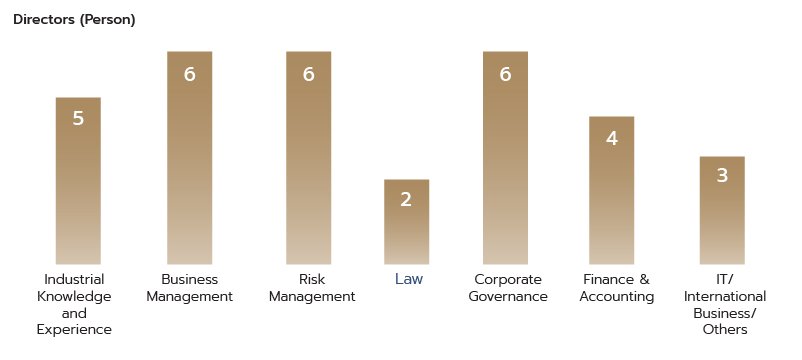
*Candidates are assessed based on educational background, work experience, professional skills, and training/seminar participation.
Currently, the Board of Directors consists of 6 directors (Male 4 and Female 2), and female directors account for 33% of the total members of the Board of Directors, which is suitable for the Company’s business operations. Each of them has experience in business areas relevant to the Company. Thus, the current Board comprises qualified individuals with experience and expertise across diverse professional fields, comprehensively covering all key aspects of the Company’s business.
Scope of Power, Duties and Responsibilities of the Board of Directors
The Board of Directors has the power, duties and responsibilities to manage the Company to be in compliance with laws, objectives and regulations of the Company, as well as the resolution of the shareholders’ meeting with lawful approval, honesty and carefulness of the Company’s benefits. The summary of important power, duties and responsibilities is as follows:
4. Review the structure of the Board of Directors, roles, duties and responsibilities of the Board of Directors, directors and senior executives, the appointment of Board committees, nomination, remuneration and development of the directors, director orientation, Board meetings, Board self-evaluation and succession plan.
5. The Board of Directors may delegate one or more directors or any other person to operate a certain task in place of the Board of Directors whilst under the supervision of the Board of Directors. The Board of Directors may authorize such person to have power within the period and to the extent that the Board of Directors deems appropriate. The Board of Directors may cancel, revoke, change, or amend such authorization as it deems appropriate.
In this regard, such delegation must not enable such persons to consider and approve the transactions for themselves, or individuals who may have conflicts of interest, personal interests, or may cause conflict of interest in any other nature with the Company or its subsidiaries (if any) (as defined in the Announcement of the Capital Market Supervisory Board and/or the Stock Exchange of Thailand and/or any other announcement of the related agency) except for approving of transactions that are in accordance with the policies and criteria as considered and approved by the Board of Directors.
8. Arrange for the preparation and submission of the audited financial statements at the end of each fiscal year, that are accurate, complete and in accordance with generally accepted accounting standards, to the shareholders’ meeting for its consideration and approval.
9. To refrain from conducting any similar or competitive business, participating as a partner in an ordinary partnership or partner with unlimited liability in a limited partnership or director in a private company or in any other firms, companies or corporations operating the business similar to or in competition with the Company, regardless of whether for his/her own benefit or for others’ benefit. However, an exception is granted where the director provides notice to the shareholders’ meeting in advance of his/her effective appointment as director of the Company.
10. To notify the Company without delay in the event of the likelihood that the director may have direct or indirect interests as a result of (i) the Company’s entry into any agreement, and (ii) his/her increased or decreased holding of shares or bonds in the Company or its subsidiary companies.

11. Ensure the Company has sound and efficient risk management policies, strategies, and standards coupled with the risk culture.
12. Ensure the Company periodically reviews its internal control system that covers the whole organization and ensure that there is a suitable risk management system or approach with supporting measures and control methods to appropriately and efficiently reduce the impact on the business of the Company.
13. To perform other duties as required by laws.
The Board of Directors determines the Company’s operational strategy and approves a business plan and budget (Corporate Plan) that reflects the Company’s vision and strategic direction for future operations, with clear and measurable objectives, for management to implement and evaluate performance. The Board also requires management to report performance analysis to the Board as progress updates to ensure that operations are successfully carried out in accordance with the established objectives.
The Company places emphasis on operating the business effectively under the principles of good governance, and the Company discourages making transactions with interrelated individuals or transactions that may involve conflicts of interest. In this regard, in the event of such transactions, the Audit Committee will perform a thorough investigation, report and propose to the Board of Directors for approval.
The Board of Directors is responsible for prescribing the good corporate governance policy, including the implementation and practice, covering the display of information related to operating performance in different aspects; financial information, risk management, investment, liquidity, assets and liabilities, legal compliance, rules and regulations, as well as the review and follow-up to ensure compliance. The Board of Directors shall consider the report and information with care and caution to be aware of key signals, for instance, the tendency for interest rates, higher risks on various aspects, failure to comply with the law and regulations, as well as other issues that may impact the Company’s credibility. The Board’s self-assessment shall also be conducted to identify ways for further improvement in the future.
The Company has implemented a code of conduct for directors, executives, and employees to use as guidelines. The Company’s code of conduct covers fairness toward shareholders, realization of the rights of all stakeholders, abstinence from any actions that cause conflicts of interest, responsibility towards the Company’s assets, abstinence from the use of insider information for one’s benefit, accurate and timely disclosure of information and responsibility toward society and the public.
The Company has implemented a code of conduct that serves as guidelines for directors, executives, and staff to follow. The Company’s code of conduct covers fairness toward the shareholders, realization of the rights of all stakeholders, abstinence from any actions that result in conflicts of interest, responsibility towards the Company’s assets, abstinence of usage of internal information for one’s benefit, accurate and timely disclosure of information, and responsibility toward society and the public.
Prevention of Conflicts of Interest
The Board of Directors exercises due care to prevent potential conflicts of interest. Accordingly, the Board has established guidelines for the Company, directors, executives, and employees in entering into related party transactions, including the determination of measures and procedures for the approval of such transactions, as well as policies or directions regarding related party transactions in the future. These guidelines are designed to ensure compliance with the Securities and Exchange Act, as well as the rules, regulations, notifications, or requirements of the Stock Exchange of Thailand and other relevant regulatory authorities. In addition, the Company discloses information on related party transactions in the financial statements and the Form 56-1 One Report to enable shareholders to review and verify such transactions. The key details are as follows:
- Avoid any actions in contradiction to the Company’s interest, whether arising from contacting people related to the Company’s trading business, such as trade partners, customers, competitors, or using opportunities or information derived from their directorship or staff position, for their own benefit. In addition, conflicts of interest may result from entering into a business that competes with the Company or engaging in other work not covered by the Company’s business that affects their duties and responsibilities.
- Avoid holding shares in a competing business with the Company that may cause the directors, executives and employees to act or omit to perform their duties or affect their duties and responsibilities.
- In the case that directors, executives and employees have held shares, whether through inheritance, in a competing business with the Company before being the director, executive or employee of the Company or before the Company has operated its business, they shall report such holding to the Company for acknowledgement.
- In case that the Board of Directors has the authority to approve the related party transaction, there must be an independent director or audit committee member attending the Board meeting.
- The Board of Directors determined that a director and an executive shall report his/her Interest or interest of a related person by filling out the Form of Report on Interest of the Directors, Executives, and Related Persons as follows: (i) Initial reporting within seven (7) working days from the date of appointment, and (ii) Subsequent reporting within three (3) working days from the date of changes in securities trading. Such information will be used for consideration of related transactions which may cause a conflict of interest and may lead to benefit transfer of the Company and for monitoring the interest of the director and executive or related person. Hence, a company secretary shall submit a copy of such report to the Chairman of the Board of Directors and the Chairman of the Audit Committee within seven (7) days from the date of receipt.
- In case any of the related party transactions is in the form of financial assistance, the Board of Directors has set guidelines for those matters in the regulations of implementation and approval, which were approved by the Board of Directors.
- The Board of Directors determined that the related party transactions must be disclosed by detailing the name of the person who may have a conflict of interest, relationship, type of transaction, conditions, pricing policy and the value of the item, reason and necessity and opinions of the Audit Committee and/or the Board of Directors according to the regulations from the Stock Exchange of Thailand.
- A person who has an interest in any agenda items shall not be permitted to vote and attend a meeting while such agenda item is being considered and resolved.
Prevention of Conflicts of Interest
The Board of Directors exercises due care to prevent potential conflicts of interest. Accordingly, the Board has established guidelines for the Company, directors, executives, and employees in entering into related party transactions, including the determination of measures and procedures for the approval of such transactions, as well as policies or directions regarding related party transactions in the future. These guidelines are designed to ensure compliance with the Securities and Exchange Act, as well as the rules, regulations, notifications, or requirements of the Stock Exchange of Thailand and other relevant regulatory authorities. In addition, the Company discloses information on related party transactions in the financial statements and the Form 56-1 One Report to enable shareholders to review and verify such transactions. The key details are as follows:
- Directors, executives, and employees shall refrain from using inside information for their own benefit in buying or selling the Company's securities, or from providing inside information to any other person for buying or selling the Company's securities.
- Directors, executives, and employees who have access to inside information are prohibited from buying or selling the Company's securities during the period of thirty (30) days before the public disclosure of the financial statements and for seven (7) days after such disclosure (the "Blackout Period").
- Directors and executives are required to report their holdings of the Company's securities (including those of their spouses and minor children) and any changes in such holdings to the Securities and Exchange Commission in accordance with applicable laws.
- Directors and executives are required to notify the Board of Directors, through the Company Secretary, at least one (1) day in advance before buying or selling the Company's securities.
Thus, the Company has established a Securities Trading and Inside Information Policy and a Conflict of Interest Policy, which form part of the Company's Code of Conduct, and has published these policies on the Company's website at www.ifscapthai.com. The Company also provides annual training to directors, executives, and employees to ensure knowledge and understanding of these matters.
To enhance work effectiveness, the Board of Directors conducts an annual self-assessment of the Board and its sub-committees, providing directors with an opportunity to review their performance. This self-assessment serves as an important tool for evaluating the appropriateness of the Board’s composition and the effectiveness of its performance in accordance with the principles of good corporate governance. The Board reviews and analyzes the evaluation results, suggestions, and key observations to make improvements and better align its practices with the nature of the Company’s business operations.
The assessment of performance on a collective basis.
The areas to be assessed are:
- Board structure and qualifications
- Roles and responsibilities of the board
- Board meetings
- The board’s performance of duties
- Relationship with management
- Self-development of directors and executive development
The assessment of performance on an individual basis.
The areas to be assessed are:
- Board Structure and qualifications
- Roles and responsibilities of the board
- Board meetings
Self-Assessment Procedures
The company secretary will submit the form of self-assessment of the Board and Sub-Committee to all members so that they can assess their performance during the past year on a collective basis and an individual basis (self-assessment). Then, the completed forms will be sent back to the company secretary for collection, analysis and conclusion, which will be reported to the Board of Directors for acknowledgement.
The results of the Board’s 2025 self-assessment, based on the Company’s evaluation form, indicate that the Board of Directors and the Audit Committee achieved a full score of 4, representing 100%, or a Very Good rating. The Board remains committed to continuously improving its performance to strengthen good corporate governance and enhance effectiveness.
The Board of Directors convenes meetings regularly in accordance with applicable laws, the Company’s Articles of Association, and the principles of good corporate governance to deliberate and make decisions on the Company’s business operations. The Board holds at least 4 meetings a year, with the annual meeting schedule communicated to all directors in advance at the end of the preceding year, including clearly defined timeframes for each meeting. Additional meetings are arranged as required. A meeting invitation letter, together with a clear agenda and sufficient supporting documents, is provided to directors at least seven (7) days before the meeting, except in urgent cases, to allow adequate time for review. In addition, the Board provides an opportunity for management to participate in the meetings to answer any queries. A quorum of at least two-thirds (2/3) of the total number of directors is required at the time of passing Board resolutions. Meeting minutes are accurately prepared in writing and kept on record for future reference.
In 2025, the directors attended the Board meetings, the Sub-Committee meetings, and the 2025 Annual General Meeting of Shareholders, all of which were held physically and electronically as shown below:
|
Directors
|
Positions
|
***Board of Directors
(6 members) |
Audit Committee
(3 members) |
Compensation and Nomination Committee
(3 members) |
Annual General Shareholders’ Meeting 2025 (Physical AGM)
|
|---|---|---|---|---|---|
| Total Number of Meetings (Times/Year) |
5
|
4
|
1
|
1
|
|
| 1. Mr. Randy Sim Cheng Leong** |
Director, Chairman of the Board, and Member of the Compensation and Nomination Committee
|
5/5
|
1/1
|
0/1
|
|
| 2. Mrs. Churairat Panyarachun* |
Independent Director, Chairperson of the Audit Committee, Member of the Compensation and Nomination Committee
|
5/5
|
4/4
|
1/1
|
1/1
|
| 3. Mr. Sutee Losoponkul* |
Independent Director, Member of the Audit Committee, and Chairman of the Compensation and Nomination Committee
|
5/5
|
4/4
|
1/1
|
1/1
|
| 4. Mr. Taveesak Saengthong* |
Independent Director and Member of the Audit Committee
|
5/5
|
4/4
|
1/1
|
|
| 5. Ms. Chionh Yi Chian |
Director
|
5/5
|
1/1
|
||
| 6. Mr. Tan Ley Yen |
Director and CEO
|
5/5
|
1/1
|
Remark:
* Independent Director
** The Chairman could not attend the 2025 AGM due to illness.
*** The Board of Directors has engaged in overseeing the risk management of the Company.
- To review the Company’s financial reporting process, to ensure that it is accurate and adequate;
- To review the Company’s internal control system and internal audit system, to ensure that they are suitable and efficient, and determine the independence of the Company’s internal audit unit and approve the appointment, transfer, and dismissal of the chief of the Company’s internal audit unit or any other unit in charge of the internal audit;
- To review the Company’s compliance with the law on securities and exchange, the rules and regulations of the Securities Exchange, and the laws relating to the Company’s business;
- To consider, select and nominate an independent person or persons for appointment as the Company’s auditor or auditors, and recommend his/her or their remunerations, and to have a meeting without Management with said auditor or auditors at least once a year;
- To review Connected Transactions or transactions that may lead to a conflict of interests, to ensure that they conform with the laws, as well as the rules and regulations of the Securities Exchange, and are rational and in the best interest of the Company;
-
To prepare and have included in the Company’s annual report a Report of the Audit Committee signed by the Chairman of the Audit Committee and containing at least the following particulars:
- an opinion on the accuracy, completeness and reliability of the Company’s financial report;
- an opinion on the adequacy of the Company’s internal control system;
- an opinion on the compliance with the law on securities and exchange, the rules and regulations of the Securities Exchange, or the laws relating to the Company’s business;
- an opinion on the suitability of the auditor(s);
- an opinion on the transaction(s) that may lead to a conflict of interests;
- the number of meetings of the Audit Committee and the meeting attendance record of each Audit Committee Member;
- an opinion or overview on the performance of duties of the Audit Committee in accordance with the Charter;
- such other things within the scope of duties and responsibilities assigned by the Board of Directors that should be made known to the shareholders and general investors;
- To oversee the Anti-Corruption Policy and Procedures, the Whistle-Blowing Policy and Procedures of the Company and their program to ensure compliance with legal and ethical obligations.
-
To perform such other acts as may be assigned by the Board of Directors with the approval of the Audit Committee;
In the performance of its duties under paragraph one, the Audit Committee shall be directly accountable to the Board of Directors who shall be responsible to the outsiders for all operations of the Company.
In the event of there having been made any change to the duties of the Audit Committee, the Company shall, within three (3) days from day on which such change takes place, disclose to the Securities Exchange the resolution on such change and the names and changed scope of duties of the Audit Committee, on the form prescribed by the Securities Exchange.
-
In performing its duties, if it discovers or suspects that there has occurred any of the following transactions or acts which may significantly affect the financial position and results of the operation of the Company, the Audit Committee shall report it to the Board of Directors for rectification to be made within the period of time the Audit Committee thinks fit:
- a transaction that involves a conflict of interest;
- dishonesty or irregularity or material defect in the internal control system;
- a violation of the law on securities and exchange, the rules and regulations of the Securities Exchange, or the laws relating to the business of the Company.
If the Board of Directors or the Management fails to effect a rectification within the time period specified in paragraph one, any Audit Committee Member may report to the Office of the Securities and Exchange Commission or the Securities Exchange that there has occurred such a transaction or act as stated in paragraph one.
- The Audit Committee has power to require any executive and staff member of the Company to deliver up any data, information and documents for use in the discharge of its duties.
- The Audit Committee has power to invite any Director, executive, staff member, internal auditor and adviser of the Company, as well as any auditor, external auditor and other person connected with any of the businesses within the duties and responsibilities of the Audit Committee, to attend any meeting of the Audit Committee as it may deem appropriate.
- To recommend the remuneration structure of the Board of Directors’ and Committees’ members including meeting allowances, bonus, welfare and other benefits both in monetary and non-monetary terms;
- To evaluate the corporate performance of the Company to determine bonus and annual salary increase across the Company, taking into account appropriate industry benchmarks;
- To recommend the Company’s salary structure and other benefits;
- To consider, comment and evaluate on the Employee Stock Option Program (ESOP) for directors and employees;
- To recommend the structure and composition of the Board and Committees together with the qualifications of its members;
- To recommend the list of nominees for the Board of Directors to be proposed to the Shareholders’ General Meeting in case of vacancies by rotation and to the Board of Directors in case of casual vacancies; and
- To perform the scope of duties and responsibilities as assigned by the Board of Directors.
Directors’ Remuneration
The Company determines a clear and transparent director remuneration policy by comparing remuneration packages with those provided by leading listed companies in the SET and comparable companies in the same industry, taking into account the company’s business performance and experience, duties, roles and responsibilities of the directors to attract and retain qualified directors. The remuneration structure is determined in the form of annual remuneration, meeting allowances and bonus in accordance with the specified criteria.
1. Annual Basic Fee and Meeting Attendance Fee
The Board of Directors resolved to propose the 2025 AGM to approve the annual basic fee and meeting attendance fee of the directors at the same rate as 2024, as detailed below:
|
Board of Directors
|
Annual Basic Fee (Baht)
|
Attendance Fee/Meeting (Baht)
|
|---|---|---|
| Chairman |
140,000
|
25,000
|
| Deputy Chairman |
110,000
|
20,000
|
| Director |
80,000
|
20,000
|
|
Audit Committee
|
Annual Basic Fee (Baht)
|
Attendance Fee/Meeting (Baht)
|
|---|---|---|
| Chairman |
110,000
|
25,000
|
| Member |
75,000
|
20,000
|
|
Compensation and Nomination Committee
|
Annual Basic Fee (Baht)
|
Attendance Fee/Meeting (Baht)
|
|---|---|---|
| Chairman |
75,000
|
25,000
|
| Member |
50,000
|
20,000
|
Remark: Executive directors will not receive such remuneration and meeting allowances.
2. Bonus
The 2025 Annual General Meeting of Shareholders resolved to approve bonus to the Company’s directors for 2024 based on their duties, responsibilities, and performance, which were the same as those paid last year.
In this regard, the payment of the directors’ remuneration under Items 1 and 2 to the directors representing IFS Capital Limited (Singapore), the Company's major shareholder, shall be made to the name of IFS Capital Limited (Singapore).
3. Other benefits
Apart from monetary remuneration, the Company has not provided any other benefits to the directors.
The 2025 Annual General Meeting of Shareholders resolved to approve the remuneration and bonus of Directors as follows:
|
Name / Position
|
2025
|
Total (Per Director)
|
||||
|---|---|---|---|---|---|---|
|
Annual Basic Fee (Baht)
|
Meeting Attendance Fee for the Board of Directors (Baht)
|
Meeting Attendance Fee for the Audit Committee (Baht)
|
Meeting Attendance Fee for the Compensation and Nomination Committee (Baht)
|
Bonus (Baht)
|
||
| 1. Mr. Randy Sim Cheng Leong Director Chairman of the Board Member of the Compensation and Nomination Committee |
190,000
|
125,000
|
-
|
20,000
|
714,000
|
1,049,000
|
| 2. Mrs. Churairat Panyarachun Independent Director Chairperson of the Audit Committee Member of the Compensation and Nomination Committee |
240,000
|
100,000
|
100,000
|
20,000
|
357,000
|
817,000
|
| 3. Mr. Sutee Losoponkul Independent Director Member of the Audit Committee Chairman of the Compensation and Nomination Committee |
230,000
|
100,000
|
80,000
|
25,000
|
357,000
|
792,000
|
| 4. Mr. Taveesak Saengthong Independent Director Member of the Audit Committee |
155,000
|
100,000
|
80,000
|
-
|
357,000
|
692,000
|
| 5. Ms. Chionh Yi Chian Director |
80,000
|
100,000
|
-
|
-
|
357,000
|
537,000
|
| 6. Mr. Tan Ley Yen* Director and CEO |
-
|
-
|
-
|
-
|
-
|
-
|
| Total |
895,000
|
525,000
|
260,000
|
65,000
|
2,142,000
|
3,887,000
|
Remark: No other benefits apart from remuneration above.
* Executive director will not receive such remuneration and meeting allowances.
Remuneration for Executivesn
Executives’ remuneration packages are reviewed by the Compensation and Nomination Committee before the Board of Directors’ approval based on their roles, duties and responsibilities, performance and dedication.
In 2025, the Company paid remuneration which consisted of salary and bonus to 8 executives of Baht 32,630,662 and other forms of employee benefits for 8 executives of Baht 34,408,813 in total.
Remuneration of the Auditors
The Company paid remuneration to the Auditors of Deloitte Touche Tohmatsu Jaiyos Audit Co., Ltd. in the form of both Audit Fee and Non-Audit Fee*, such as group reporting fee, fee for review and audit of financial information of the joint venture and out-of-pocket expenses and other actual expenses e.g. overtime pay and traveling expenses as follows:
|
|
Year 2024
|
Year 2025
|
|---|---|---|
| Audit Fee |
2,265,000
|
2,330,000
|
| Non-Audit Fee* |
250,056
|
892,875
|
|
Total
|
2,515,056
|
3,222,875
|
In 2025, the Company oversaw and ensured adherence to policies and practices related to its business operations in the following areas
Prevention of Conflicts of Interest
The Company placed importance on good corporate governance in managing conflicts of interest to enhance transparency and confidence among all stakeholder groups. Accordingly, policies and practical guidelines on this matter have been established for the Company’s directors, executives, and employees at all levels. Any transactions involving conflicts of interest must strictly comply with the Company’s guidelines and relevant notifications of the Securities and Exchange Commission (SEC). Accordingly, the Company implemented measures to prevent conflicts of interest as follows:
- The Company monitored newly appointed executives, as defined by the Securities and Exchange Commission (SEC), to ensure that they prepare reports on their own interests and those of related persons, and submit them to the Company Secretary within the specified period. Such reports are subsequently submitted to the Chairman of the Board and the Chairman of the Audit Committee within seven (7) business days from the date of receipt. The Company also monitored directors and executives whose interests have changed to ensure that they prepare and submit updated reports to the Company within the specified period.
- The Company requires disclosure of material related-party transactions, detailing the names of persons with potential conflicts of interest, their relationships, the nature and terms of the transactions, pricing policies, transaction values, reasons and necessity for such transactions, and the opinions of the Audit Committee and/or the Board of Directors, in compliance with the regulations of the Stock Exchange of Thailand.
- The Company has established whistleblowing channels to enable the reporting of potential conflicts of interest via email at whistleblowing@ifscapital.com. In addition, the Company has published the procedures for filing complaints and the investigation process on its website. (www.ifscapthai.com)
- The Company ensures that all newly appointed directors and newly hired employees are informed of the policies and practices relating to interests and conflicts of interest and are required to acknowledge and agree to comply by signing. The Company also monitors to ensure that they read and acknowledge any revisions or amendments to such policies and practices.
- The Company developed e-learning materials for the “Conflict of Interest Policy” course to review key principles on this matter, together with a post-training assessment to test understanding. All directors, executives, and employees participated in the training, representing a 100% participation rate.
In 2025, the Company received no reports of misconduct, whistleblowing, or complaints regarding conflicts of interest contrary to the criteria prescribed by regulatory authorities and the Good Corporate Governance Principles.
Prevention of Use of Inside Information
The Company emphasizes the governance of inside information to prevent directors, executives, and employees from using inside information for personal gain or the benefit of others, which could harm the Company or its shareholders. Accordingly, the Company has established policies and guidelines on the use of inside information to ensure transparent and fair operations. Any inside information not yet disclosed to the public—such as financial information, operating results, key projects, changes in shareholding structure, or other information that may materially affect investment decisions—may affect the Company’s securities. Therefore, directors, executives, and employees with access to such information are required to maintain strict confidentiality.
The Company implemented monitoring measures on the use of inside information by directors, executives, and employees as follows:
- The Company prohibits directors, executives, and employees from using inside information to trade the Company’s securities or from disclosing such information to any person for securities trading purposes. The Company has established “blackout periods” before and after the disclosure of material financial information and provides advance notification to relevant persons on an ongoing basis.
- Directors and executives have a duty to report their holdings of the Company’s securities and any changes thereto, including holdings of their spouses and minor children, to the Securities and Exchange Commission (SEC). They are also required to submit copies of such reports to the Company within the legally prescribed period to enable transparent monitoring and disclosure.
- The Company has implemented strict control and monitoring measures to ensure compliance with this policy, including the imposition of disciplinary actions in cases of non-compliance.
- The Company arranged an e-learning course on “Securities Trading and the Use of Inside Information” for all directors, executives, and employees, achieving a 100% participation rate. The training aimed to refresh their knowledge and understanding and to foster a corporate culture that adheres to the Good Corporate Governance Principles, transparency, and verifiability.
In 2025, none of the Company’s directors or executives engaged in insider trading, and there were no cases in which the Company was fined, accused, or charged in civil proceedings by any regulatory authorities, such as the Securities and Exchange Commission or the Stock Exchange of Thailand, in relation to the use of inside information by the Company’s directors or executives.
Report on Changes of Securities Holdings
The Company stipulates that directors, executives, and persons holding positions higher than or equivalent to the manager of the finance and accounting function, who are required to report securities holdings, must report the holdings and any acquisition or disposal of the Company’s securities by themselves, their spouses, and their minor children to the Securities and Exchange Commission (SEC) in accordance with Sections 59 and 246, and the related penalty provisions under Sections 275 and 298 of the Securities and Exchange Act B.E. 2535 (as amended). Any violation of the foregoing requirements will be subject to appropriate disciplinary actions, such as written warning, reduction of remuneration, suspension, or termination, as deemed appropriate.
In 2025, the Company’s directors and executives reported their securities holdings and those of related persons as follows:
|
Name - Surname
|
Position
|
Securities Holdings in IFS
|
|||
|---|---|---|---|---|---|
|
As of 31st December 2025
|
Shareholding Proportion (%)
|
As of 31st December 2024
|
Number of Shares: Increase (decrease) during the year
|
||
| Directors | |||||
| Mr. Randy Sim Cheng Leong |
Director, Chairman of the Board, and the Compensation and Nomination Committee Member
|
-
|
-
|
-
|
-
|
| Spouse and Minor Child (ren) |
-
|
-
|
-
|
-
|
-
|
| Mrs. Churairat Panyarachun* |
Independent Director, Chairperson of the Audit Committee, and the Compensation and Nomination Committee Member
|
-
|
-
|
-
|
-
|
| Spouse |
-
|
-
|
-
|
-
|
-
|
| Mr. Sutee Losoponkul* |
Independent Director, the Audit Committee Member, and Chairman of the Compensation and Nomination Committee
|
-
|
-
|
-
|
-
|
| Spouse |
-
|
-
|
-
|
-
|
-
|
| Mr. Taveesak Saengthong* |
Independent Director, and the Audit Committee Member
|
-
|
-
|
-
|
-
|
| Spouse |
-
|
-
|
-
|
-
|
-
|
| Ms. Chionh Yi Chian |
Director
|
-
|
-
|
-
|
-
|
| Spouse |
-
|
-
|
-
|
-
|
-
|
| Mr. Tan Ley Yen |
Director & CEO
|
210,000
|
0.04
|
210,000
|
-
|
| Spouse |
-
|
-
|
-
|
-
|
-
|
| Executives | |||||
| Mr. Tan Ley Yen |
CEO
|
210,000
|
0.04
|
210,000
|
-
|
| Spouse |
-
|
-
|
-
|
-
|
-
|
| Ms. Areeya Kanchanabat |
CFO
|
-
|
-
|
-
|
-
|
| Spouse and Minor Child (ren) |
-
|
-
|
-
|
-
|
-
|
| Mr. Paknam Sarakul |
GM, Legal and Recovery
|
105,005
|
0.02
|
105,005
|
-
|
| Spouse |
-
|
-
|
-
|
-
|
-
|
| Mrs. Sutida Supanugoolsamai |
GM, Risk Management
|
99,300
|
0.02
|
99,000
|
300
|
| Spouse |
-
|
-
|
-
|
-
|
-
|
| Mr. Voon Ee Huei |
GM, Business Development
|
-
|
-
|
-
|
-
|
| Spouse and Minor Child (ren) |
-
|
-
|
-
|
-
|
-
|
| Mrs. Pensri Pettong |
Head, Finance and Accounts
|
-
|
-
|
-
|
-
|
| Spouse |
-
|
-
|
-
|
-
|
-
|
| Mr. Perapong Srivipapattana |
Vice President, Client Relations
|
-
|
-
|
-
|
-
|
| Spouse |
-
|
-
|
-
|
-
|
-
|
| Mr. Weerachai Adunchroenthong |
Vice President, Operations and Information Technology
|
-
|
-
|
-
|
-
|
| Spouse and Minor Child (ren) |
-
|
-
|
-
|
-
|
-
|
Remark: * Independent Director
Fraud and Anti-Corruption
The Board of Directors places importance on combating all forms of corruption, with a commitment to conducting business with transparency, ethics, and good corporate governance. The Company assesses business risks that may be related to corruption, establishes clear operational guidelines to control, prevent, and monitor corruption-related risks, and has adopted an Anti-Corruption Policy and a Zero-Tolerance Policy against corruption. The objective is to prevent the Company, its directors, executives, and employees, as well as other persons (such as third parties) performing duties related to the Company, from violating anti-corruption laws. The Company provides communication and training on anti-corruption policies and practices and establishes review and oversight procedures to ensure strict compliance with this policy. In this regard, the Company has prepared an Anti-Corruption Measures Manual and discloses details of such policy on the Company’s website www.ifscapthai.com under the topic “Corporate Governance.”
Therefore, to build confidence among the Company’s stakeholders in conducting business with social responsibility, the Company has become a member of the Thai Private Sector Collective Action Against Corruption (“CAC”). The CAC approved the renewal of the Company’s membership certification for a second term of three years, effective from 30 December 2023 to 30 December 2026.
In 2025, no incidents of corruption, either internal or external, were reported.
Whistleblowing
The Company has a Whistleblowing policy and procedures that offer protection for the whistleblowers as a Whistleblowing channel for people within the Company and other stakeholders to submit their complaints or concerns regarding any behavior that may cause inappropriate, unethical actions or may cause violation of the law, financial misconduct or fraud directly to the Chairperson of the Audit Committee (the “Chairperson”) via an e-mail: whistleblowing@ifscapthai.com or regular mail specify “Private & Confidential” to the address as follows:
Chairperson of the Audit Committee
IFS Capital (Thailand) Public Company Limited
1168/55, 20th Floor, Lumpini Tower,
Rama 4 Road, Tungmahamek,
Sathorn, Bangkok 10120
The Chairperson of the Audit Committee will consider complaints directly and/or appoint an independent investigation committee to conduct the investigation. Details of the relevant policy and procedures are disclosed on the Company’s website at www.ifscapthai.com under “Corporate Governance.”
In 2025, there were no whistleblowing reports or complaints from stakeholders under the Company’s whistleblowing policy and procedures for reporting misconduct and protecting complainants.
Protection of Confidential Information of Clients
The Company gives precedence to the confidentiality of information belonging to customers and related persons, such as shareholders, directors, and employees. The Company provides a Privacy Notice in compliance with the Personal Data Protection Act, B.E. 2562 (2019). It also provides channels and procedures for handling complaints from customers regarding their personal data. Details of this matter are disclosed on the Company’s website (https://investor.ifscapthai.com/th/privacy-notice). In addition, the Company has established regulations and practice guidelines relating to personal data processing for compliance by its executives and employees.
In 2025, the Company arranged an in-house training for all executives and employees to refresh their knowledge and test their understanding of the Personal Data Protection Act (PDPA), related regulations and notifications, as well as the importance of personal data protection within the organization. The participation and completion rate of the training and assessment was 100%.
In 2025, no complaints or incidents regarding the personal data of customers and relevant stakeholders were reported.
Annual Review of Corporate Governance and Code of Conduct (covering relevant corporate governance-related policies, practices, and internal guidelines of the Company)
The Board of Directors conducts an annual review of corporate governance and the Code of Conduct to ensure that the Company’s policies, practices, and internal guidelines relating to corporate governance remain appropriate, up to date, and consistent with applicable laws, regulatory requirements, recognized best practices, and the evolving business environment. The review covers the Corporate Governance Policy, Code of Conduct, Anti-Corruption Policy, Conflict-of-Interest Policy, Whistleblowing Policy, Inside Information Policy, Personal Data Protection Policy, as well as other relevant guidelines and manuals.
When updates are required, the Board approves them and ensures that directors, executives, and employees are informed and comply accordingly.
In 2025, the Company reviewed its Corporate Governance Policy and Code of Conduct, as well as related policies, practices, and guidelines, to ensure they provide effective guidance for operations and comply with good corporate governance principles. The results were reported to the Board for acknowledgment.
In 2025, there were no cases of non-compliance with corporate governance principles or the Code of Conduct.
Human Resources
In 2025, there were a total of 89 executives and employees broken down by departments as follows:
|
Departments
|
No. of staff
(Person) |
|---|---|
| Executives |
9
|
| Business Development |
15
|
| Client Relations |
12
|
| Credit Risk Management |
2
|
| Operations |
27
|
| Information Technology |
1
|
| Customer Credit |
4
|
| Finance and Accounts |
3
|
| Legal & Recovery |
2
|
| IR, Secretariat and Compliance |
2
|
| Credit Review |
6
|
| Human Resources and Administration |
5
|
| Executive Secretary |
1
|
|
Total
|
89
|
In 2025, there were no significant changes in employees and there had been no labor disputes.
The remuneration paid to the employees (excluding directors and executives) was:
|
Types of Remuneration
|
2024 (Baht)
|
2025 (Baht)
|
|---|---|---|
| Monthly salary/Bonus |
59,326,294
|
58,081,851
|
| Welfare expenditure for staff |
17,147,957
|
18,100,557
|
|
Total
|
76,474,251
|
76,182,408
|
Other Cash Remuneration
The Company is registered under the Provident Fund Act, which requires provident fund contributions by both employee and employer. Each employee is required to contribute 5-15% of their salary, and the Company has to pay another portion as stipulated by the fund regulations.
In 2025, there were 74 employees in the Provident Fund, which accounted for 83 percent of the total employees with the total amount of Baht 49.40 million.
Policies in Developing Human Resources
The Company recognizes the importance of knowledge and competency development for its employees as it will cause an increase in their competency and quality of services. Therefore, the Company consistently provides in-house and external training and seminars to all staff or individual to increase skills and knowledge on their jobs. The Company also rewards its employees appropriately to motivate and retain their services in the long run. In addition, the Company also supports activities to motivate and encourage bonding among staff.
Succession Planning
The Board of Directors is aware of the importance of succession planning in the positions of Chief Executive Officer and Senior Managers. To this end, the Compensation and Nomination Committee will review succession planning annually to prepare the recruitment plan when a position becomes vacant, or when an executive is unable to perform his / her duties due to retirement.
Compliance Unit of the Company
The Company has established the Investor Relations, Secretariat and Compliance Department. The Compliance unit shall be the center of overseeing the Company’s business operation to ensure that it complies with all related laws, rules and regulations, obligations, policies, and requirements, such as the Securities and Exchange Commission, the Stock Exchange of Thailand, the Department of Business Development, the Ministry of Commerce, etc. The policies and practices necessary to the Company’s operations are provided and reviewed every year to ensure that they are relevant to all related laws and rules. They are also communicated to all employees and related persons for acknowledgment, right practice, and strict compliance with rules.
Governance and Management Policy for a subsidiary, associate company, or joint venture
The Company has established a Governance and Management Policy for a subsidiary, associate company, or joint venture (the “Policy”) to maintain the Company’s investment interests to be more efficient and maximize shareholders’ and all stakeholders’ benefits. Furthermore, the Company aims to govern and manage the operation of a subsidiary, associate company, or joint venture in line with the Company's policies, the Public Limited Companies Act, the Civil and Commercial Code, the Securities and Exchange Act, as well as related notifications, regulations, rules, and applicable laws. This policy has been published on the Company’s website www.ifscapthai.com under Corporate Governance.
In 2024, the Company invested in a joint venture company, Beyond Leasing Co., Ltd. (“BYL”), which operates its core business such as financial services covering operating lease, financial lease, hire-purchase, and related financial services. BL was registered as a juristic person with the Business Development Department of the Ministry of Commerce on 9 May 2024 with a 49% stake owned by the Company.